In, on, and at are very useful for talking about time and place. And although they are very simple words, they are often challenging for English learners.
Some languages have very different ways of describing time and place. So, this can be tricky.
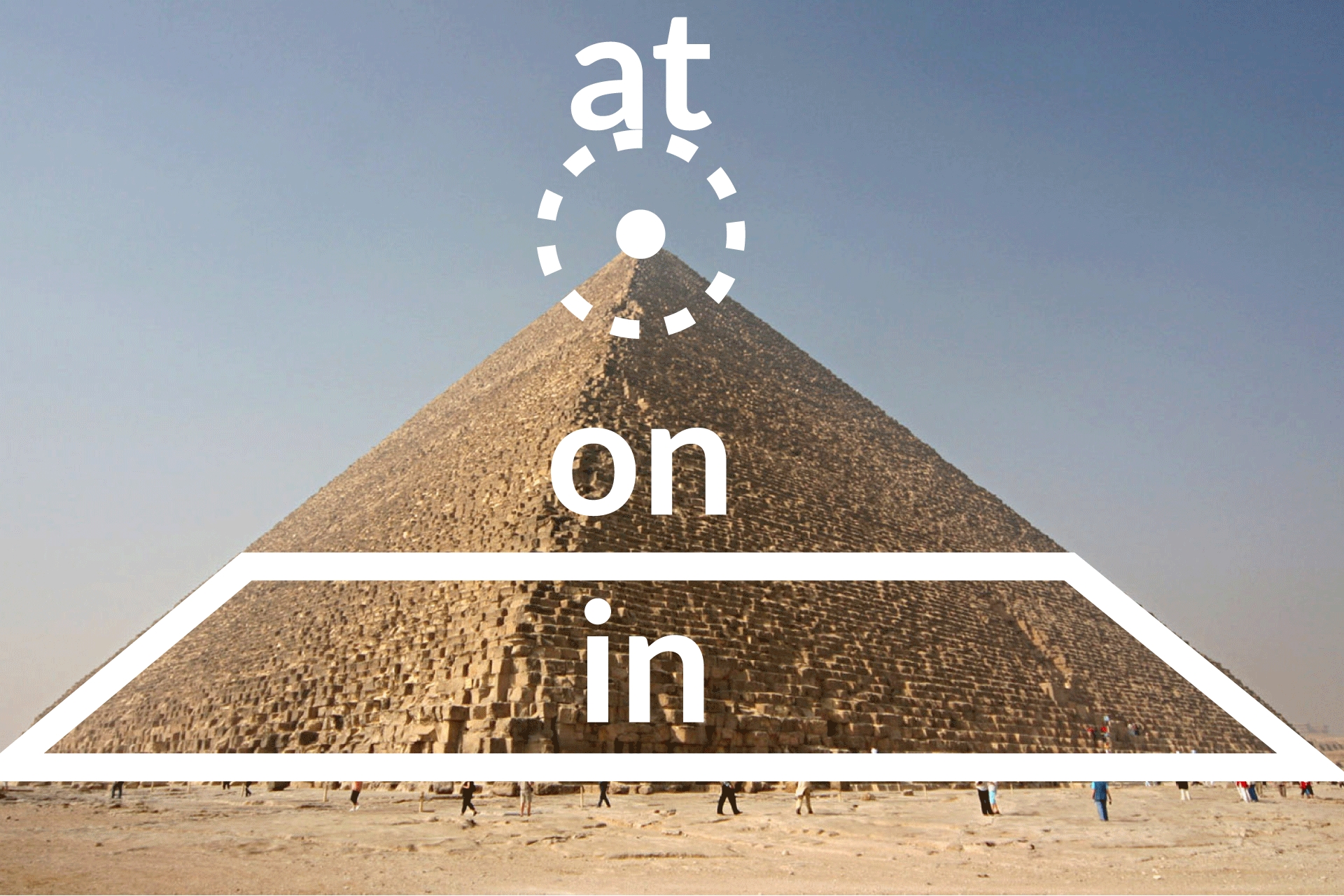
One popular tool for learners is the in-on-at pyramid. Here is a take on this pyramid, with some extra information added:

If you do a quick internet search, you’ll find lots of images and video that present pyramid images to learners as a way of remembering some of the uses of these words. The basic pyramid is all about size. But…
It’s not about size.
The pyramid suggests using at for smaller things and shorter times, on for middle-sized things and times, and in for bigger things and longer times.
But in the real world, they don’t seem to be paired up so neatly. There are many situations when at is bigger than on or in, and when on is bigger than in.
On the plane, in the cockpit, at the airport
In the morning, on Monday, at the weekend
And to say where something is, often in, on, or at can be used.
I’m in the park.
I’m at the park.We’re on the beach.
We’re at the beach.She’s on the boat.
She’s in the boat.
Yes, people really say “in the boat” and “on the boat”. The difference is the way we imagine the boat.
This raises some questions:
- What do these words mean?
- Why are these words often used the way they are, with in for bigger things and at for smaller things?
What do these words mean?
Look at the blue lines we’ve added to add what the words mean. Here is a 3D version:

Rather than remembering a rule of thumb, think about what these words mean.
To do so, we need to think about how people think about space and physical objects.
- At basically refers to a point.
- On basically refers to a surface.
- In basically refers to a container.
And these same basic ideas apply when thinking about time. We can’t see time the way we can see physical objects, so we talk about time in the same way we talk about the physical world.
Why are these words often used the way they are, with in for bigger places and at for smaller places?
When people talk about something big, a good way is to say where it starts and ends. We might not be able to see where the start and end is, but we know it exists (like for countries and cities). The thing we are talking about is located somewhere in the middle.
When something is smaller, we can generally see a lot of its surface. So, we can say something is on this surface.
When something is even smaller, it is easier to simply refer to it as a point. It is small so it isn’t necessarily touching the point, but it is close. It is at the point.
How about time?
The same applies for time. We measure bigger time periods from start to end. For example: years, decades and centuries.
The surface of a three-dimensional object doesn’t have a clear start and end. A shorter time period (such as day), might not have a clear start and end. People’s days start and end at different times, when they wake up and go to sleep – it’s not clear when.
And of course, a point in time (such as 12:51AM) is shorter than a period (there is no start and end).
Words have meaning
For a lot of big places and times, it makes sense to use in because of how we imagine it. On makes sense for a lot of smaller places and times. And at makes sense for points in space or time.
The reason is because of the meaning of the words.
The in-on-at pyramid is a nice way to tie these ideas together, to give a visual representation. But adding the meanings of these words is a great addition. No matter what the situation is, you can understand whether in, on or at fits best.