Author: Eldridge Carl

  • Grammar Practice: From Broken English to Natural Sentences

    Grammar Practice: From Broken English to Natural Sentences

    Last week, one of my university students came and spoke with me after class. She loves movies, and said that through doing this activity, she felt she understood more English in movies.

    This activity is different from many activities I find in textbooks. Instead of passively getting used to English, students actively focus on what grammar to expect.

    We have been doing this practice for around six weeks (part of a class, once a week). Yet, it is already making an impact.

    The students in this class are currently second-year university students. They have been studying English through their schooling and although they have studied grammar and listening before, their skills are still lacking. This activity seems to be getting them on the right track.

    The activity: simple yet powerful

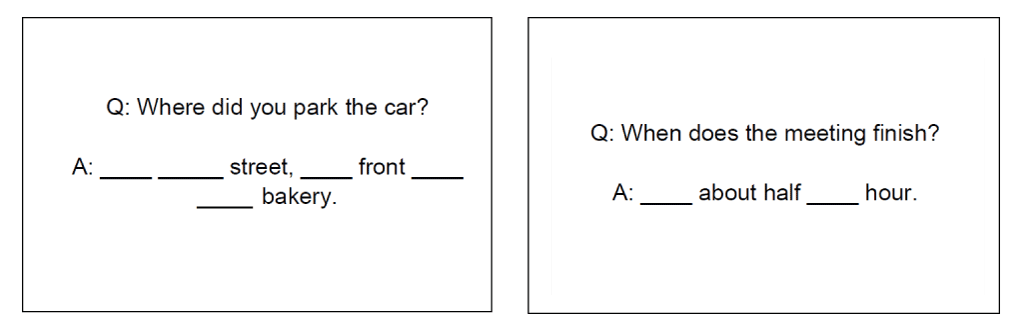
    The activity is as simple as taking a text in English, in this case short questions and answers, and removing the grammar.

    Like this:

    Familiarity

    This practice helps students develop a sense of what words go where. This works because it reflects what we do when communicating in real life.

    Expert speakers are very familiar with English and predict the words coming next.

    Through this practice students become familiar with common phrases and patterns of English that are necessary for them to become fluent speakers.

    Meaning and Pictures

    Being familiar is one thing, but it makes an even bigger impact when it’s meaningful.

    When students are stuck, and don’t know which word fills the gap, they are often unaware of the kind of information an English speaker is expecting. As a teacher, you can guide and support them to help them think more like an English speaker.

    The following strategies are useful in this activity, and when giving feedback in general.

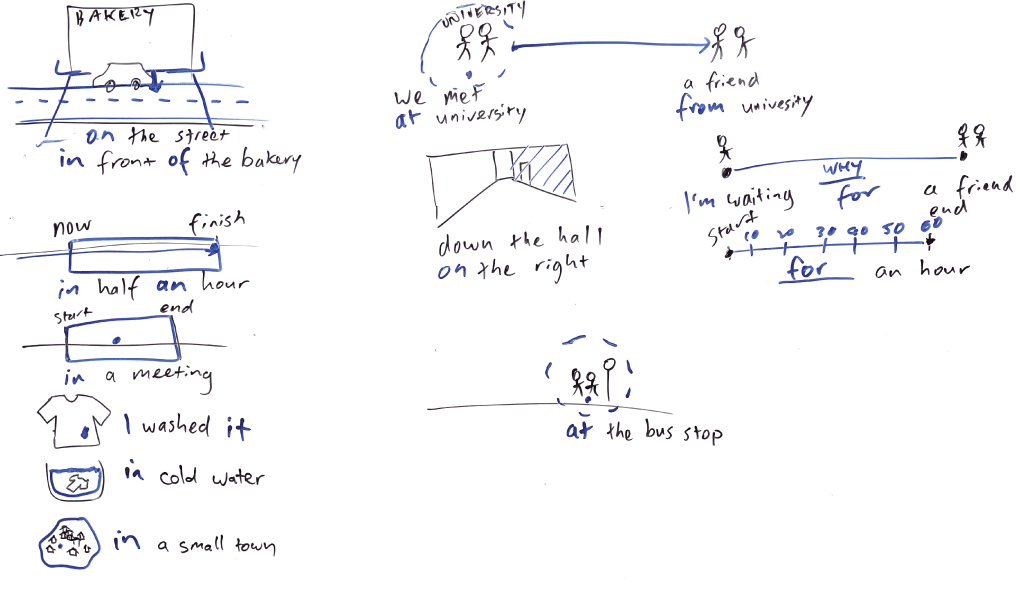
    I start by saying the kind of information that is needed: who, what, where, etc. When they don’t know the exact meaning that needs to be conveyed, an illustration can clear things up.
    As students continue studying, they see patterns in the words and also patterns in the images. They develop there sense of what words like ‘in’, ‘at’, and ‘for’ mean.

    I’ve written more about using images like this to help students understand grammatical meaning in the book Grammar Without Rules: The Visual Method Students Actually Enjoy.

    Why studying grammar improves listening skills

    When listening to English it’s very hard for students to catch high-frequency grammatical words (I, you, it, the, in, at, etc.). These words are often not articulated clearly because they don’t have to be. Moreover, the student’s first language may not have equivalents for these words so the fact that English has them often seems mysterious, and using them does not come naturally.

    On the other hand, an expert listener expects these words, so even a hint of the sound is enough for us to process it.

    And not pronouncing these words clearly actually makes communication smoother! Because these words are subtle, by contrast, the vocabulary that is less predictable and carries meaning stands out.

    Students will hear people speaking fast and not every word will be clear. This is a beautiful thing about English. It’s light and shade. And it’s something students will need to get used to in order to speak fluently. However, many students can’t hear it.

    This is largely due to the fact that they struggle to predict what is coming next.

    When we do listening activities with students, it’s natural to just ask them to keep listening until they get it. But when they don’t get it, they may think it’s impossible, which is extremely demotivating. Instead, you can help them through an activity that is achievable and builds the underlying skill that makes listening easier. When listening, expecting the words coming makes it much easier to catch them.

    Grammar Practice to Improve Speaking Skills

    When we learn a language, we mimic what we hear. It’s no surprise that students who can’t hear natural English, have difficulty speaking it.

    Traditional grammar rules try to solve this by giving students a step-by-step process to form sentences. But this doesn’t reflect the thought processes expert speakers use when communicating in real life. (Many expert speakers don’t know the rules!)

    We know the patterns. We know the meaning. We unconsciously predict.

    Through practice, students strengthen their ability to do this.

    The way it works in the activity I’ve described above strikes a balance. Students actively produce sentences using all necessary grammar, in context, with support.

    Focused attention on the patterns of English with the support of a teacher can help students develop their sense of how English works while bypassing a lot of the guesswork that comes with just listening and figuring it out for themselves.

    Once students can hear and process English, this familiarity with patterns is exactly what they need when forming their own sentences.

    When speaking, they unconsciously predict the words they will need next, and the language flows.

    This awareness is key. Mastering grammar is not about mastering the points. It’s about being aware of the patterns and which words fit. This skill that all expert speakers have enables us to listen and speak with ease.

    “Real Grammar” is about developing this sense, which is a combination of being familiar with the patterns and understanding the underlying meaning, and how it comes together for clear communication.

    Teaching or Self-Study

    I’ve written this with the teacher in mind but this method also works well for self-study.

    For beginners, start with basic sentences and become familiar with the patterns. Write the sentences you want to be able to say, then write them again with gaps for the grammar. Put them aside, and come back later and see if you have the grammar to fill the gaps. Keep practicing until the words flow naturally and keep including more and more sentences.

    If you’re an intermediate student and you want to better understand the grammatical meaning and how it all fits, check out Real Grammar: Understand English. Clear and Simple.

    For teachers (of all levels) and advanced students who want a deeper understanding, check out Grammar Without Rules: The Visual Method Students Actually Enjoy.

    Feel Free to Get in Touch

    If you find this useful or have any questions or comments, feel free to contact me here.
  • Mind Brain Ed Think Tank: L2 Grammar and the Brain

    Mind Brain Ed Think Tank: L2 Grammar and the Brain

    I recently wrote an article on Understanding English Grammar Through Visual and Experiential Models for the Mind Brain Ed Think Tank: L2 Grammar and the Brain.

    I hope it gives you some ideas for helping students understand grammar in the classroom. We can move away from traditional usage rules and focus more on understanding what the grammatical words mean.

    I’ve learned a lot about a the how the brain works and how to use this knowledge to become a better language teacher through the Mind Brain Ed Think Tanks. I highly recommend them to anyone interested in neuroscience and how it can be applied to education.


    Do you have any other ways of making grammar study more meaningful and brain-friendly? Please let me in the comments below.


  • The IN-ON-AT Pyramid: Does size matter?

    The IN-ON-AT Pyramid: Does size matter?

    In, on, and at are very useful for talking about time and place. And although they are very simple words, they are often challenging for English learners.

    Some languages have very different ways of describing time and place. So, this can be tricky.

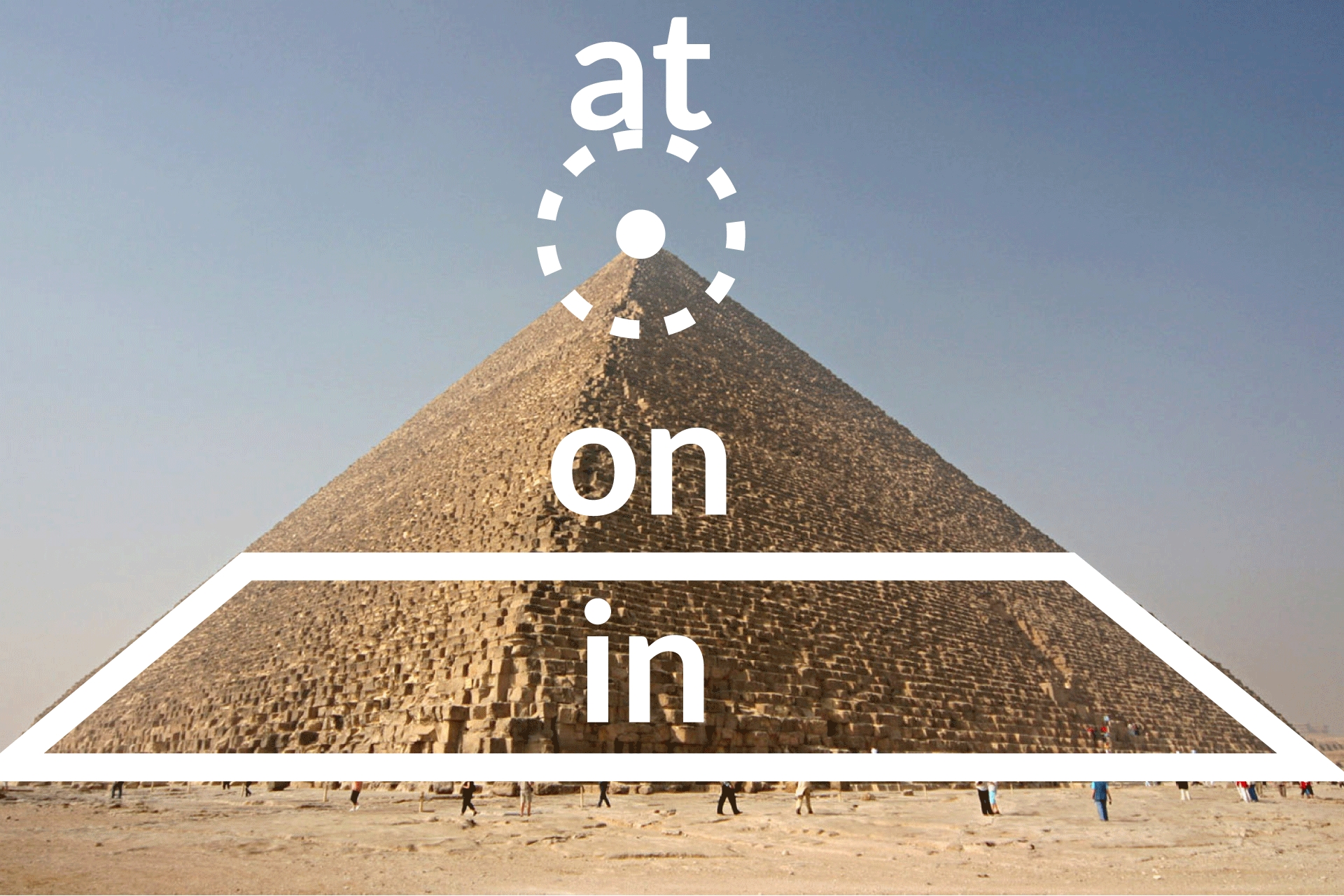
    One popular tool for learners is the in-on-at pyramid. Here is a take on this pyramid, with some extra information added:

    in-on-at pyramid - showing the meaning of these prepositions

    If you do a quick internet search, you’ll find lots of images and video that present pyramid images to learners as a way of remembering some of the uses of these words. The basic pyramid is all about size. But…

    It’s not about size.

    The pyramid suggests using at for smaller things and shorter times, on for middle-sized things and times, and in for bigger things and longer times.

    But in the real world, they don’t seem to be paired up so neatly. There are many situations when at is bigger than on or in, and when on is bigger than in.

    On the plane, in the cockpit, at the airport

    In the morning, on Monday, at the weekend

    And to say where something is, often in, on, or at can be used.

    I’m in the park.
    I’m at the park.

    We’re on the beach.
    We’re at the beach.

    She’s on the boat.
    She’s in the boat.

    Yes, people really say “in the boat” and “on the boat”. The difference is the way we imagine the boat.

    This raises some questions:

    • What do these words mean?
    • Why are these words often used the way they are, with in for bigger things and at for smaller things?

    What do these words mean?

    Look at the blue lines we’ve added to add what the words mean. Here is a 3D version:

    in-on-at pyramid in 3D showing meanings of these prepositions


    Rather than remembering a rule of thumb, think about what these words mean.

    To do so, we need to think about how people think about space and physical objects.

    • At basically refers to a point.
    • On basically refers to a surface.
    • In basically refers to a container.

    And these same basic ideas apply when thinking about time. We can’t see time the way we can see physical objects, so we talk about time in the same way we talk about the physical world.

    Why are these words often used the way they are, with in for bigger places and at for smaller places?

    When people talk about something big, a good way is to say where it starts and ends. We might not be able to see where the start and end is, but we know it exists (like for countries and cities). The thing we are talking about is located somewhere in the middle.

    When something is smaller, we can generally see a lot of its surface. So, we can say something is on this surface.

    When something is even smaller, it is easier to simply refer to it as a point. It is small so it isn’t necessarily touching the point, but it is close. It is at the point.

    How about time?

    The same applies for time. We measure bigger time periods from start to end. For example: years, decades and centuries.

    The surface of a three-dimensional object doesn’t have a clear start and end. A shorter time period (such as day), might not have a clear start and end.  People’s days start and end at different times, when they wake up and go to sleep – it’s not clear when.

    And of course, a point in time (such as 12:51AM) is shorter than a period (there is no start and end).

    Words have meaning

    For a lot of big places and times, it makes sense to use in because of how we imagine it. On makes sense for a lot of smaller places and times. And at makes sense for points in space or time.

    The reason is because of the meaning of the words.

    The in-on-at pyramid is a nice way to tie these ideas together, to give a visual representation. But adding the meanings of these words is a great addition. No matter what the situation is, you can understand whether in, on or at fits best.

  • Do we really say, “Tomorrow will be Friday”?

    Do we really say, “Tomorrow will be Friday”?

    Tomorrow will be Friday. It’s a simple English sentence. Sentences like this are very common in English language teaching, but is this something a native English speaker would typically say?


    Early in a child’s study, they are taught the days of the week. Teaching the days of the week often includes drilling questions and answers like this:

    “What day is it today?” “Today is Thursday.”

    “What day was it yesterday?” “Yesterday was Wednesday.”

    “What day will it be tomorrow?” “Tomorrow will be Friday.”

    Any student in a class like this would think that this is how native speakers typically talk about days of the week.

    It’s not.

    The more natural sentence is:

    “What day is it tomorrow?” “Tomorrow is Friday.”

    Many teachers have been asking questions like “What day will it be tomorrow?” for as long as they can remember. But, if we stop and think, when do people actually say, “Tomorrow will be Friday”?

    Well, it is possible, but quite unusual.

    This raises the question of what we teach. Do we teach what the book says is “correct”, or teach the language that people use in everyday life? My students want to develop skills to communicate with people in real life.

    So, what sentences do people usually use?


    People typically say: “Tomorrow is Friday.”

    “Tomorrow is Friday” is the more common sentence, used in most situations. Here is some data from the Corpus of Contemporary American English (COCA):

    tomorrow is...day / tomorrow will be...day frequency graph

    In real life tomorrow will be… is not usually used to simply express what day it is tomorrow.

    98% of the examples use Tomorrow is… to refer to a day of the week. These sentences simply say what day tomorrow is:

    ROBIN ROBERTS: Death At A Funeral opens in theaters tomorrow, tomorrow’s Friday, TGIF.

    CHRIS ROCK: Tomorrow’s Friday, yeah.

    Even when we’re not talking about days, Tomorrow is… is far more common and useful than Tomorrow will be…


    tomorrow will be... tomorrow is... frequency graph

    The examples of tomorrow will be… in COCA typically refer to predictions or decisions for tomorrow, such as:

    Tomorrow will be a good/better day. – prediction
    Tomorrow will be a day of (mourning/prayer). – decision


    Although will is less common in the sentences and graphs above, it is a very useful word in English. So when teaching, we should provide students with examples of how will is really used. In English there are many expressions that are used when talking about the future. When we give students authentic examples, they can develop a sense of how people use will and what it really means.

    Learning real-life English

    If the student’s goal is to communicate with people in real life, it makes sense for the teacher to teach the English that people use in real life.

    But teachers also need teaching resources. Many teachers tend to grab a book and teach from it. “Tomorrow will be…” is in textbooks, so many teachers accept it and teach it.

    And this make sense. It is a perfectly grammatical sentence and people understand what you are trying to say if you use it.

    But is it what people say?

    Think about your own experiences with English. Look at the data above or go to a corpus and have a look for yourself. Is it common to use “tomorrow will be…” to simply refer to what day tomorrow is?

    When the goal is to speak with other English speakers in real life, it makes sense to learn and use the same structures that people commonly use.

    Getting the basics right

    People use sentences the way they do because it makes sense to them to do so. It fits in with their understanding of how the language works.

    When students practice basic sentences as they are naturally used, it helps them develop their own sense of how the language works.

    After learning vocabulary or a grammar point in class, it often doesn’t really stick until we encounter people using it naturally.

    I know that for me (learning Japanese), I often see people use what I learn and think “ah, so that’s how they do it!” Seeing this gives me confidence to use the structure myself.

    But when the grammar that students are taught in class and real-life English doesn’t match, it only causes problems. It is hard to make the connection between what we learn and what people say.

    We shouldn’t be surprised that many students have trouble making sense of English tenses and other grammar, because they’re often fed strange sentences from the beginning of their studies that simply don’t match real-world usage.

    A misunderstanding at the basic level is likely to cause bigger problems as students progress in their studies. Students will have trouble understanding more complex grammar simply because they haven’t understood the basics.

    If a structure doesn’t fit the situation, so why lead students to believe that it does?

    We can continue to follow tradition and teach will as a future tense marker, but at what cost?

    Looking for a good grammar book that gets the basics right?

    Grammar helps people understand each other better.

    If you are interested in a grammar book that looks at common parts of English sentences and what they mean, and how people often use them (like will on this page), be sure to check out Real Grammar.

    With Real Grammar you understand grammatical meaning. Grammatical meaning helps you understand more of what people say in English.

    Real Grammar is grammar for communication.

    Get the book - Real Grammar: Understand English. Clear and simple.

    Resources

    Here is a chart for presenting yesterday, today, and tomorrow, and the days of the week to young learners. The sentences are simple and are what people usually use in everyday life.

     yesterday was, today is, tomorrow is: A chart for teaching the days of the week
  • The day after tomorrow

    The day after tomorrow

    I often thought it was strange that many students come up with these long and complex sentences such as “I will go to the beach the day after tomorrow”, when they could have just said “I’m going to the beach on Sunday”. Ignoring the awkward use of will for now, why would they say that mouthful “the day after tomorrow” when they could simply say “on Sunday”?

    The difference comes from translating ideas into English that don’t fit:
    In Japanese, more words are used to express days.

    一昨日 昨日 今日 明日 明後日 明々後日
    yesterday today tomorrow

    The kanji for 明後日 best translates to “the day after tomorrow”, so it seems like this particular expression has been adopted.

    But is it actually a practical English expression? Let’s have a look at how it is used.


    “The day after tomorrow” isn’t very common

    Here is some data from the Corpus of Contemporary American English (COCA).

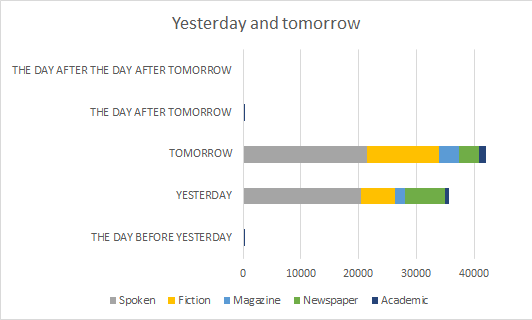
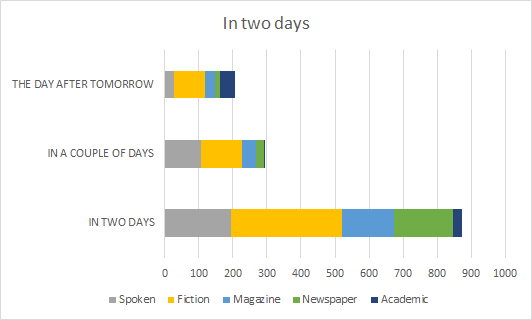
    The expression “the day after tomorrow” (207) isn’t anywhere near as common as “today”(259153), “yesterday” (35593), and “tomorrow” (42025).

    The day after tomorrow - yesterday, today and tomorrow - graph

    Even if we look at the graph without “today”, “the day after tomorrow” is barely visible.

    The day after tomorrow - Yesterday and tomorrow - graph

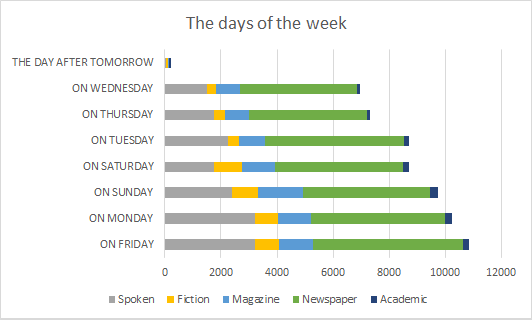
    Using the days of the week is far more common.

    The day after tomorrow Vs the days of the week - graph

    There are other expressions that are more common for talking about the day after tomorrow.

    The day after tomorrow and other expressions - graph

    but something here still looks a bit odd…

    Why is “the day after tomorrow” more common in academic writing than these other expressions?

    The movie: 

    Movie: The day after tomorrow

    A staggering number of the examples of “the day after tomorrow” in the corpus are referring to the movie: “The Day After Tomorrow”. In academic writing, this is 40 of the 45 examples, 90%!

    Academic 40/45: 90% 

    Magazine 19/29: 66%

    Newspapers 5/15: 33%

    Spoken 7/27: 26%

    Fiction 1/91: 1%


    Overall, this is 72/207:  35%!

    If we forget about all the examples referring to the movie, there are only a couple of main uses:

    The day after tomorrow - not the movie - graph

    In fiction

    This expression is most common in fiction writing. A good fiction writer thinks about the reader. Does the reader know what day it is? How could they, unless you say what day it is, but this is often unneeded complexity. So, authors often have to use other expressions such as “the day after tomorrow” so the reader can understand the timing of events.

    What about the other uses?

    “The day after tomorrow” can be used to make an event sound closer, like it’s almost tomorrow.

    It is often used after the word “tomorrow”. The speaker is thinking about tomorrow and the next day: the day after tomorrow.

    For example:
    If I don’t have time to watch the movie tomorrow, I’ll watch it the day after tomorrow.


    What should I say?

    If you’re writing fiction an expression such as “the day after tomorrow” might be useful, but for most situations it is unusual; simpler expressions are more common. “The day after tomorrow” can be useful if you are thinking and talking about tomorrow and want to add an extra day. But, if you are simply saying when something happens, it is easier and more natural to just use the day of the week.